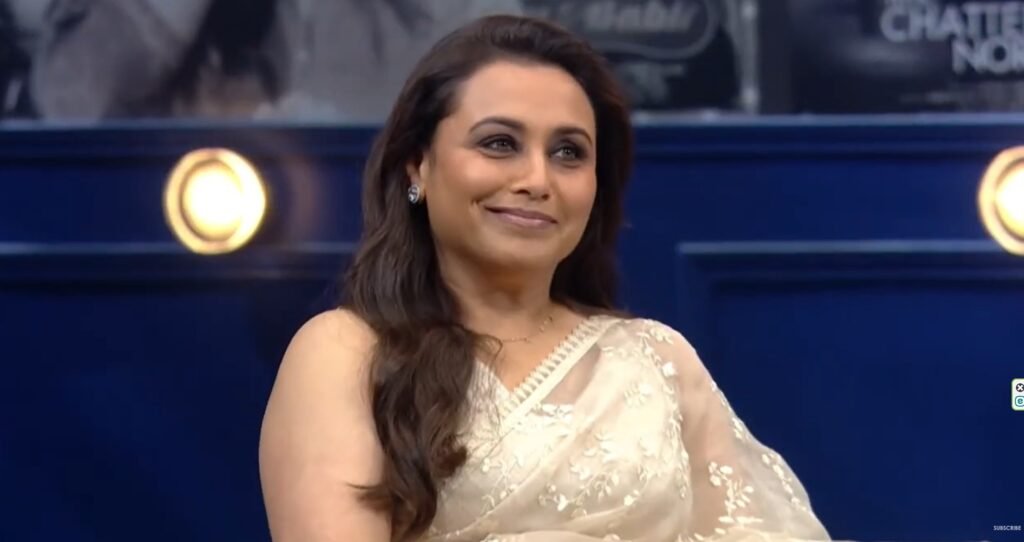
She’s 30. In films. Rani Mukerji, as per filmmaker and friend Karan Johar, has put in “30 years of groundbreaking work”. As he interviewed her at the Yash Raj Studios on her personal and professional journey in a conversation laden with humor, poignant memories and wonderful remembrances, he helped bring out the essence of the actress and human being within the star.
Summed up Rani in the beginning, “I have to thank everybody who has played a part in my journey, including the media that supported and critiqued me and helped me grow, and the directors and producers who gave me the roles I have essayed.”
About her later phase studded with several milestones, she says, “I like to be the voice of the strong Indian woman. Consciously or subconsciously, such parts always came into my life, whether it was Naina Mathur from Hichki, or Shivani from Mardaani.”
Rani added, “I come from a humble Bengali family. We were not very economically sound, but my mother went through those difficult days always with a bright smile, happiness and laughter. Sometimes, it was difficult to make ends meet, and my mother was unable to buy what she wanted for me. But she was always smiling. That is a key trait I have imbibed from her, that whatever be the situation, one must smile through and go forward. I have always got support from my dad (late filmmaker Ram Mukerji). It never occurred to him that I would be an actress.”
Advertisement
Rani became an actress because producer Salim was a family friend and offered her Raja Ki Aayegi Baraat (1996). “My mother thought that I should try it out and see, and I thought that I should do my best,” recalled Rani. (Interestingly, alongside, Rani did a Bengali film called Biyer Phool, produced by her brother Raja and written and directed by her father. That film, also costarring Prasenjit was a hit and released on the same day as her Hindi debut, as per Wikipedia!)
Though Raja… did not do well, Rani and her power-packed performance were noticed. Mukesh Bhatt cast her in Ghulam with Aamir Khan and coincidentally, future husband Aditya Chopra watched her debut film and suggested her name to Karan Johar, who was directing his first film, Kuch Kuch Hota Hai with Shah Rukh Khan and Kajol. The role that Rani played had been turned down by eight heroines, who thought that it was secondary to Kajol’s in importance. Said Karan on stage, “I have to now thank those eight actresses who turned down my film!”
Rani can never forget the kindness of Aamir Khan, Shah Rukh Khan and Karan Johar. Ghulam with Aamir Khan and the song Aati kya Khandala marked the beginning of Rani’s stardom. A few months later, Kuch Kuch Hota Hai, was released and proved the biggest hit of 1998.
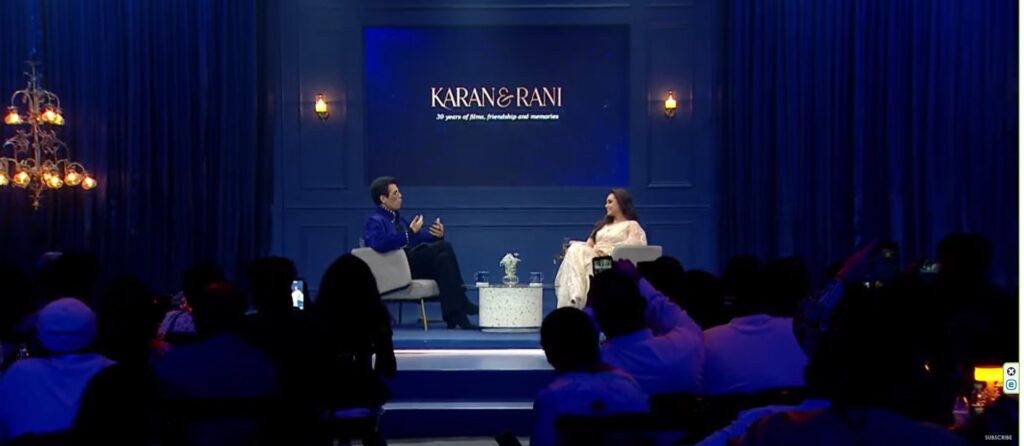
Rani was in tears recalling how Karan and his team refused to dub Rani’s voice—something that had happened in Ghulam because producer Mukesh Bhatt and Vikram Bhatt wanted it as her voice was unusual. “I love your voice!” Karan had told her.
The two Bhatts had made Aamir the fall guy, Rani stated, as he had to come and explain on their behalf why certain sacrifices had to be done for a big film. The actor passed on their message as “Probably your voice was not apt for the role”!
Rani mentioned Saathiya, Hum Tum and Kabhi Alvida Naa Kehna among her special films. “I was inspired by those characters. I always look for something that touches my heart, as I have to become the character and keep Rani aside, so that the audience believes in the characters. In these films, I was the Indian woman who does what she wants to do, fulfils her desires, and stands against conventional tenets quietly without shouting from the rooftops.”
She stated that actors get such opportunities only because writers, directors and producers have that faith in them. “Only then can actors give wings and flesh to such characters,” she feels.
Rani spoke of the deep and immersive world created by Sanjay Leela Bhansali and credited him for “every second of Black”, stating that she was “indebted to him forever for choosing me.” She stated that he made his actors go into the depths of their own selves and figure what else is there inside each, and taps what they do not know exist within them.
Meeting up deafblind people and with six months of training made her realize that these challenged individuals were proud and self-reliant and never wanted sympathy. On the contrary, they would crack jokes in their sign language and since Bhansali and her had learnt it, they themselves would crack up. The film made Rani feel “spiritual and grateful”.
However, when she did not win the National award for it, Rani admitted that it broke her parents’ and fans’ hearts. She said, “I was not working for awards, but only to make my parents’ lives better and happier.”
Rani is eternally grateful to her fans. “For three decades—I was 17 then and am 47 now—they have accepted me in every phase. Nothing has come in the way for them to believe in me and appreciate me. I have become a wife and mother since, and they believe in my work, so I have to give them what they want: better roles, better dreams. I want to do my best, make my directors happy as they are my first audience. My goal is not to win awards, which are more about recognition that the entire film gets, but to constantly keep working. Very early on, I realized that I might not get the recognition I deserve because someone else is better.”
Rani finally clinched the National award for her role in Mrs Chatterjee Vs. Norway, the real-life story of a woman separated from her kids due to the laws in a foreign country. She stated that she always kept her mom in mind when doing this challenging role. “She had a lot of ‘Bengaliness’ in her and doted on Raja and me. I modeled Mrs. Chaterjee on how she would react if separated from her kids! But it was tough doing the film as my daughter Adira was born and I could not imagine being separated from her.”
Another favorite was Hichki, about a teacher having Tourette’s Syndrome, a motor disorder that causes abnormal and involuntary facial movements. Rani regrets not meeting the Tourette’s-affected Brad Cohen, on whose autobiography the film was made. “I cannot imagine how such people face the ridicule they get from an unsympathetic world that laughs at them but does not understand them,” she stated.
Rani also has the distinction of leading the only female-driven Universe in films—the Mardaani universe of a cop who takes on social evils against women. The first episode was inspired by the Nirbhaya case and the film, written by Gopi Puthran, was born out of sheer anger, she revealed. “We wanted to make something empowering and spread awareness of what is happening around us. The more conversations we have to bring these topics out the better.” Mardaani 3releases on January 30.
Finally, Karan asked her about life with her husband, writer-filmmaker Aditya Chopra. “He is simple and likes to be really basic,” she replied with a smile. “That is something endearing to which I was drawn! He respects his parents and my family, and does not have any baggage of being who he is, or Yash uncle’s son. If he had had even an iota of ego or airs, I would never have fallen for him. And he lets me be who I am. I think that it all was meant to be, especially when I see him with our daughter Adira, which is exactly how my life used to be with dad!”
And Adira, she concludes, is a very creative child who writes very well and is a good storyteller. “She is just like her father and grandfather!” she smiles, as Karan unraveled a surprise for her—a heartfelt and surprisingly mature and articulate handwritten letter by her to Rani.