Join WhatsApp Channel

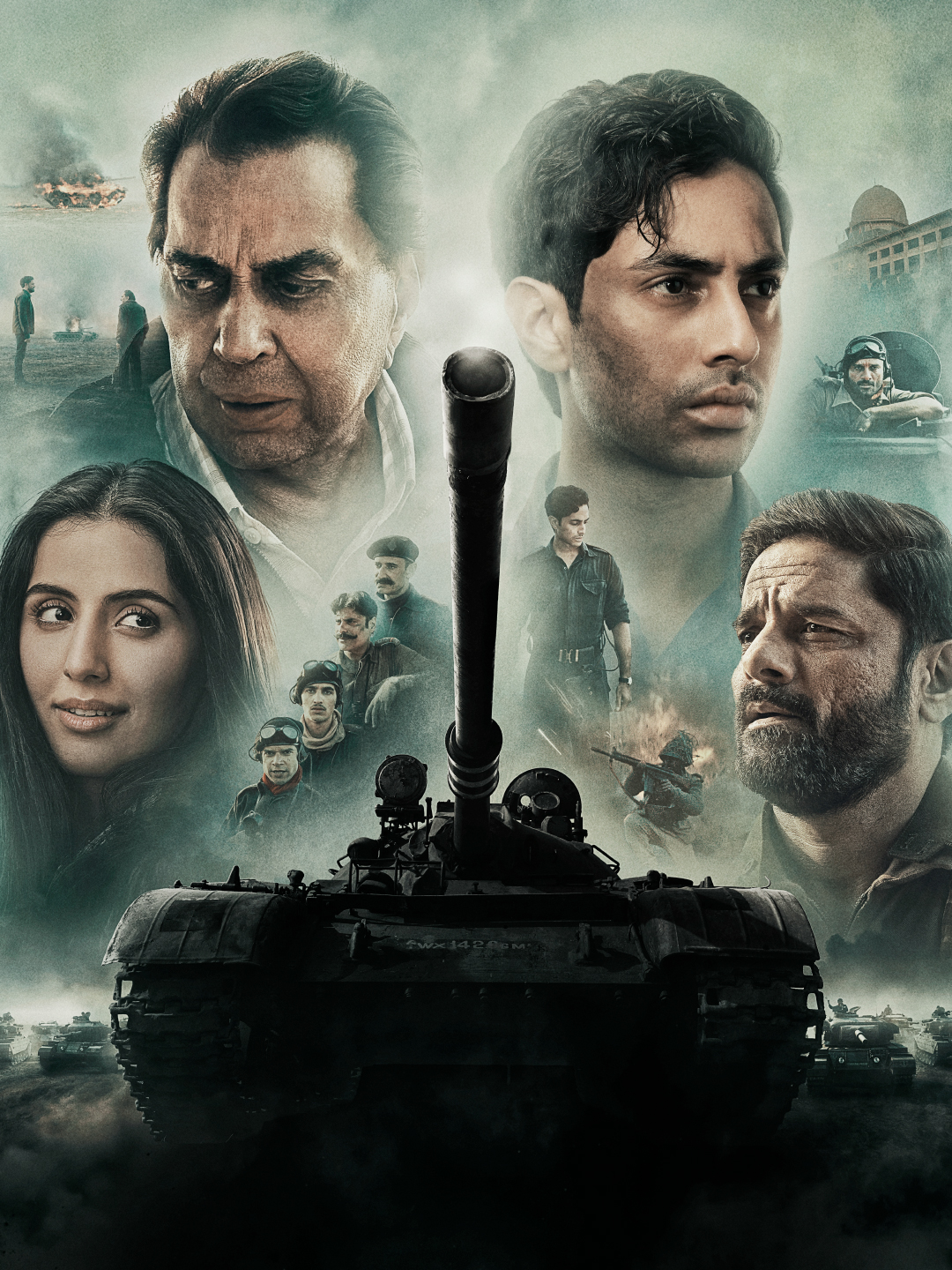
Some films are just meant to be.
And meant to become what they are. Ikkis is one such film. The life story of Second Lieutenant Arun Khetarpal of the 17th Poona Horse Regiment, who passed away at 21 (which gives the film its title) who became India’s youngest soldier to win the Param Vir Chakra—an award conferred for “most conspicuous bravery in the presence of the enemy”—has been shown before in a TV serial, a Malayalam film and in graphic novels. But this time, it has been done, employing 147 minutes of screen time, by putting equal emphasis on Arun’s father, Brigadier (Retd.) M.L. Khetarpal. The war between India and Pakistan in 1971 is thus the “base” for this saga.
At 81, Arun’s father decided to visit his hometown, Sargodha (now in Pakistan) and was welcomed by a Pakistani Brigadier, who along with his family looked after him well and guided him around his hometown and his actual home. He also took him to the exact spot where Arun had breathed his last. Intrigued, Brigadier Khetarpal asked him how he knew such intricate details.
These three pivotal characters have been essayed in Ikkis by Agastya Nanda (who was the sole dazzling spot in The Archies, the OTT release in 2023), Dharmendra as his father and Jaideep Ahlawat as the Pakistani brigadier (whose name, strangely, has been modified from Khwaja Mohammad Naser to Jaan Mohammed Nissar).
The best part about Ikkis is that the story is not told in a linear fashion, which would have made it rather dull. Sriram Raghavan, stepping out of his Hitchcockian thriller mode into war and biopic terrain with equal expertise and cinematic passion, alternates his story between the son from his commissioning into his regiment and the zealous patriotism he showed in war and the recount of the father going to Pakistan a full 30 years later in 2001.
The narration thus alternates between Arun’s war sequences and his father’s journey in Pakistan. It culminates with the revelation that the determined Arun, when the tank that he commanded caught fire and his superior had ordered him to abandon the tank, had replied on the radio, “No, Sir, I will not abandon my tank. My main gun is still working and I will get these bastards!” Arun and his unit decimated 10 enemy tanks and this was a major plus in the Indo-Pak war.
The film’s ace is the script and relaxed narration. Not for Raghavan and his co-writers (Pooja Ladha Surti and Arijit Biswas) the frenzied pace of a “normal” Hindi war film: the war sequences tell a grim and gritty real picture, of unhurried storytelling in a setting kept very real. Raghavan’s direction naturally complements this fascinating saga of extraordinary patriotism. And it is flush with equally lifelike situations like the bantering between army soldiers, their passion in battle, Arun’s romance with Kiran Kochhar (Simar Bhatia) and the way he earns the admiration and respect of his teacher and seniors, essayed by Sikander Kher, Rahul Dev and Vivaan Shah in particular.
Agastya is again extraordinary and Simar Bhatia, who makes her debut, utterly winsome in a brief role: here is an actress whose performance belies the fact that she is merely making her debut, just the way Agastya had shined in his first film.
The supporting actors mentioned above, as well as the rest, do well—Suhasini Mulay as Arun’s mother, Jitendar Singh as Sowar Nand Singh, Shree Bishnoi as Sowar Parag Singh, the driver of Arun’s tank, Vijendar Singh as Nathu Singh, Madhusudan Bishnoi as Sowar Bishwanath Singh, Kailash as Second Lieutenant Brijendra Singh, Aryan Pushkar as Second Lieutenant Avtar, Ekavali Khanna as Nissar’s wife and Avani Rai as Nissar’s daughter Saba, echoing her real-life passion for photography.
But two of the three (Agastya) concrete pillars of this superior cinematic edifice are Dharmendra and Jaideep Ahlawat. It is a masterstroke of destiny that this is the legendary senior actor’s last (and fortunately completed!) film. That he is underplayed, restrained and endearingly and charmingly natural is a no-brainer: he has always been that! But he is—in the final analysis—plain fabulous as the senior Khetarpal, and the sequence where he faces the Pakistani soldier responsible for his son’s death and his reaction show—yet again in 65 years of work—what a terrific actor he always had been! The use of the real poem penned by the actor in homage to his pind (village) is nothing but the icing on the cake!
Jaideep Ahlawat left me also flummoxed by this actor’s sheer range and talent. His eyes and his facial expressions are like textbooks in how to act wonders and his performance can only be described by the term “towering”.
Anil Mehta’s cinematography, Alexander Samokhvalov’s and Amrit Singh’s action, the make-up and costumes and the VFX (Redefine) are top-class, as is the background score by Sachin-Jigar. Monisha R. Baldawa’s editing is apt for the storyline, though the first half could have been crisper.
So far as songs (by White Noise Collectives) are concerned, they are well-worded and composed and sung as well, but there is a problem: they are used in fragmented ways: this is something that Raghavan did even with the splendid score of his AndhaDhun. Good music is something that cannot be used too less, as they not only augment a movie but give it allure: the sooner millennium filmmakers realize this the better it will be for us all, including the industry.
That apart, Raghavan’s direction is masterly, his quest for authenticity, simplicity in substance, and realism is praiseworthy. There are apt references to the futility of war and the inherent similarities between Indians and their cross-border enemies, so the tone actually is antithetic to the current national sentiment at large. But those who watch both Dhurandhar and this film will know that life has a strange duality and that both these films speak the truth despite the seeming opposite stances. Anyway, the message here is more for Pakistan, and in that respect, the film’s message matches that of Dhurandhar.
All said and done, this is a fitting end to Dharam-ji’s unmatched innings, and is deserving of a watch as a film in totality.
Rating: ****
Maddock Films’ Ikkis Produced by: Dinesh Vijan, Binny Padda, Sharada Karki Jalota & Poonam Shivdasani Directed by: Sriram Raghavan Written by: Sriram Raghavan, Pooja Ladha Surti & Arijit Biswas Music: White Noise Collectives Starring: Dharmendra, Agastya Nanda, Simar Bhatia, Jaideep Ahlawat, Suhasini Mulay, Rahul Dev, Sikander Kher, Vivaan Shah, Ekavali Khanna, Avani Rai & others. Sp. App.: Asrani, Zakir Hussain & Deepak Dobriyal