Join WhatsApp Channel


As the world continues to evolve, the human mind and behavior remain fascinatingly predictable and constant. Whether it’s the personality we show at family gatherings or the small dimple on our cheek, these details shape our individuality. But as we take a step back and reflect on ourselves, these characteristics raise the question: What really makes us who we are?
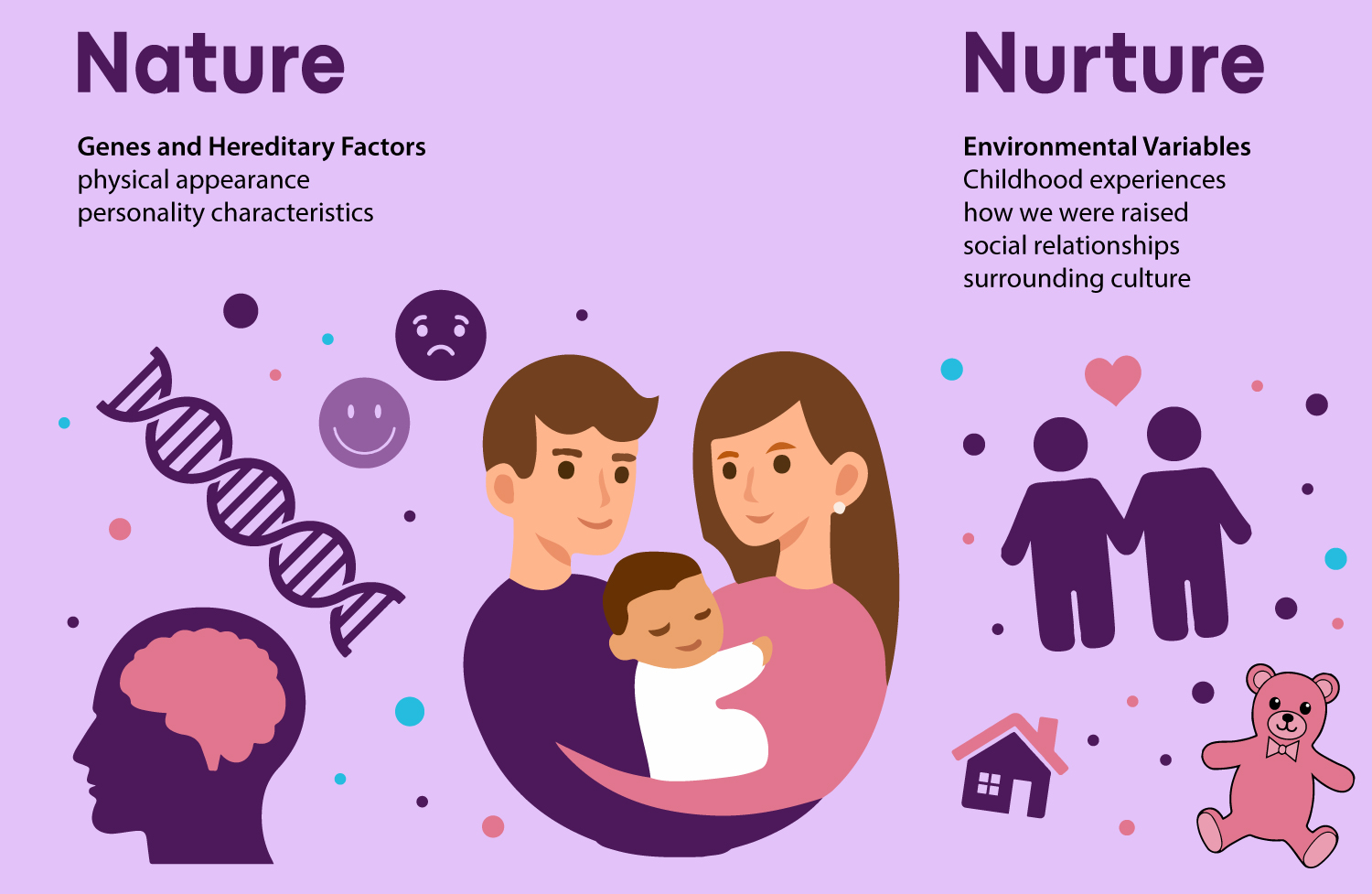
Since the 1800s, psychologists have long debated the topic of “Nature vs. Nurture,” which asks: Are we shaped more by our genetic or environmental factors? According to the book From Molecules to Minds, the answer to this question isn’t so straightforward. Most psychologists believe that people aren’t solely shaped by nature or nurture but are instead a representation of the complex connection between these factors.
For years, psychologists have researched brain plasticity, discovering the mind’s ability to generate new neurons throughout life. This ability to transform suggests that the human brain can adapt through new experiences rather than being permanently fixed by genetics, highlighting the impact of nurture. Supporting this idea, an article by Kendra Cherry from Verywell Mind describes Albert Bandura’s social learning theory experiment, which reveals the tendency of children to mimic their parents and mirror the influences around them.
This finding highlights the powerful effects of nurture, as it describes how behavior is changed and adapted to external influences to reflect the environment around an individual. On the other hand, an article by Simply Psychology emphasizes the role of biology, suggesting that the nervous system determines behavior, while hormones and neurotransmitters determine mood.
The article also highlights the impact of nature by presenting research that shows how children resemble biological parents more than adoptive ones. These findings underscore how our genes and chemical makeup reflect our behavior, personality, or attitude over the environment we grow up in, emphasizing an explanation rooted in the effects of biology on development.
While these experiments provide insight into the debate, the real question isn’t which side is right; rather, it’s how this debate impacts our daily lives. As people rooted in culture, the South Asian community is especially impacted by this phenomenon. Research from Psychology Today claims that different cultures express emotions differently. Indian society, being interdependent, expresses “socially engaging” emotions—both positive and negative—that create a greater connection with our community. Similarly, biological factors also shape who we are, determining our physical traits and health.
As the South Asian community reflects higher genetic homogeneity, certain alleles in our DNA affect how we react to treatments and increase the risk for specific chronic diseases. According to the American Diabetes Association, South Asians have a higher prevalence of type 2 diabetes and a unique body composition that raises the risk for atherosclerosis.
While the “Nature vs. Nurture” debate seeks to answer a simple question, it unfolds various complex layers in our lives that challenge our understanding of environment, culture, and genetic makeup. However, as the famous philosopher Jesse Prinz advised, “Nature and nurture conspire together. One must keep both in view.”
Disclaimer: The opinions and views expressed in this article/column are those of the author(s) and do not necessarily reflect the views or positions of South Asian Herald.