 Join WhatsApp Channel


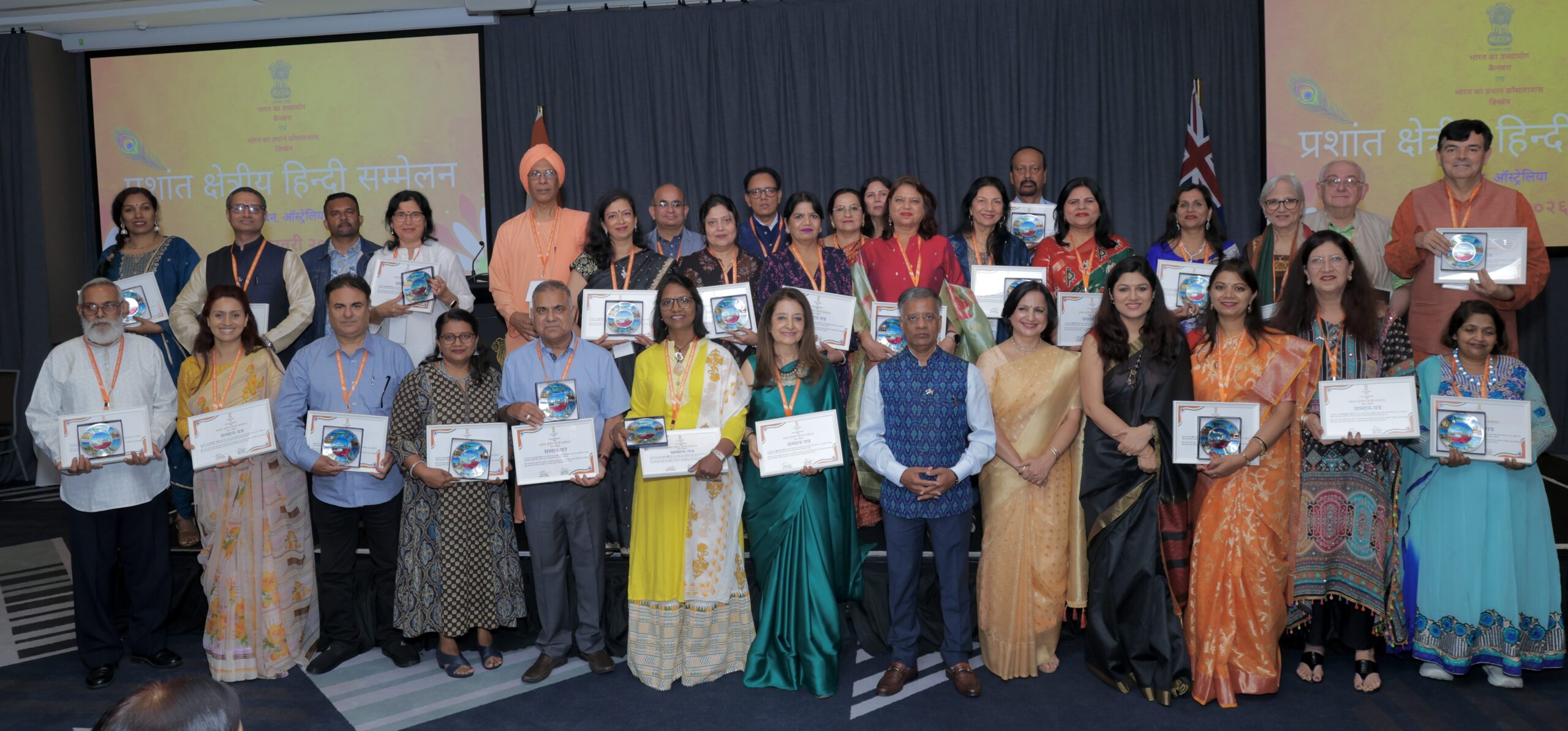
The High Commission of India in Canberra, in collaboration with the Consulate of India in Brisbane, organized the Inaugural Pacific Region Hindi Conference on January 16, 2026, at VOCO in Brisbane, Australia. The conference served as a platform bringing together scholars, writers, educators, journalists, and representatives of Hindi organizations from Australia, New Zealand, Fiji, and the Pacific Islands.
The conference opened with the ceremonial lighting of the lamp, followed by a Saraswati Vandana and collective rendition of Vande Mataram, commemorating the 150th anniversary of the song that had once unified India’s freedom movement. The ceremony was led by Neetu Bhagotia, Consul General (CG) of India in Brisbane, Neena Malhotra, Secretary (South), Ministry of External Affairs (MEA) and Gopal Baglay, High Commissioner of India to Australia.
A Journey of Connecting Cultures Through Hindi
Welcoming delegates, CG Bhagotia described the gathering as “an important symbol of Hindi’s growing global presence and the world’s connection with India.” Calling it a journey of “connecting cultures through Hindi,” she referred to the assembled scholars, writers, educators and community leaders as “the true ambassadors of the language,” noting that the conference stood as “a marker of how Hindi continues to thrive far beyond India’s borders.”
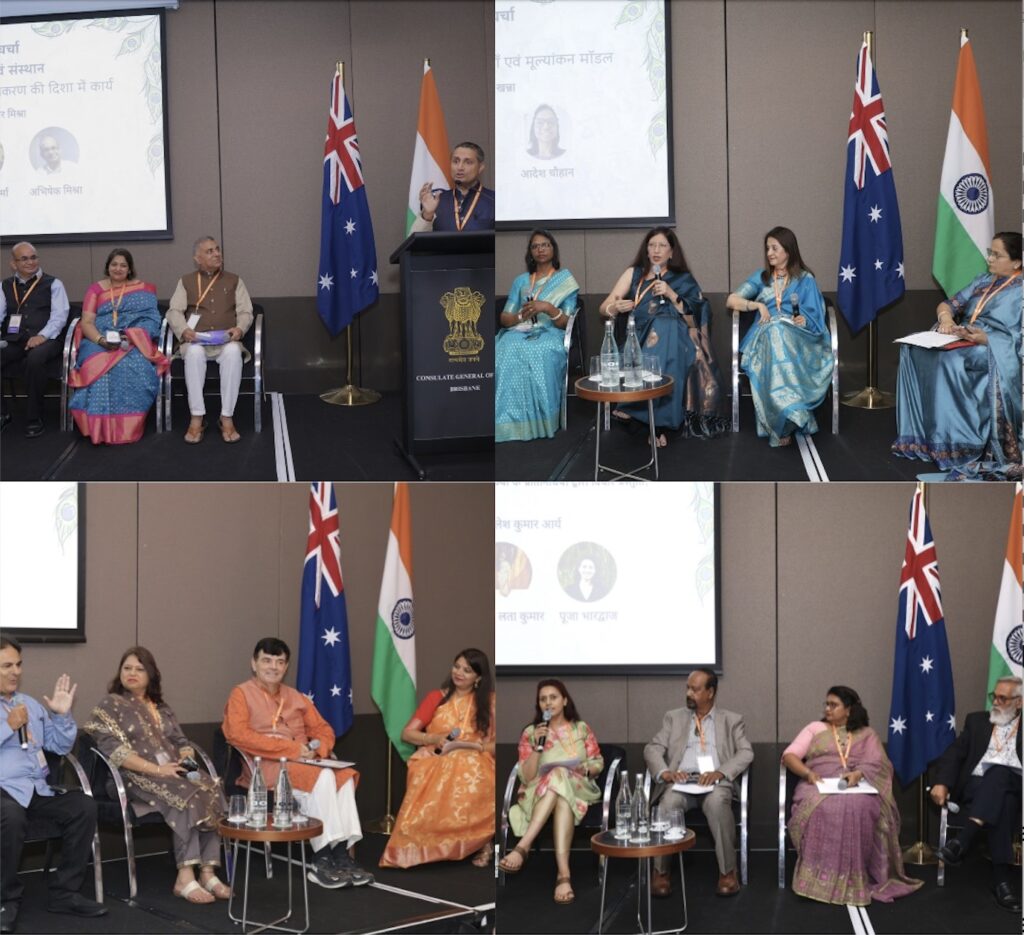
Bottom row, left to right: Panel III: Media, Digital Platforms and AI – Rohit Kumar, Jyoti Parashar and Charles Thomson Biharilal, moderated by Rashi Saxena. Panel IV: Voices from the Region – Pooja Bhardwaj (Australia), Satya Dutt (New Zealand) and Subhashini Lata Kumar (Fiji), moderated by Ambassador Kamlesh Kumar Arya. PHOTOS: Pooja Bhardwaj
Secretary Malhotra, praised the “vibrancy of language communities that flourish far beyond India” and outlined the Government of India’s efforts to strengthen Hindi teaching abroad, including the recent posting of local Hindi teachers in Wellington. Highlighting MEA’s broader outreach, she noted that “four to five regional Hindi conferences are held annually through Indian missions,” including last year’s events in Kazakhstan, Japan, Trinidad and Tobago, and Singapore. The Pacific conference, she added, reaffirmed India’s long-term commitment to nurturing Hindi beyond its geographical origins.
Setting the conference goals, Malhotra identified three priorities: preservation of Hindi’s linguistic heritage for future generations, outreach through education and technology, and engagement through stronger collaboration among organizations and institutions across the region. Reiterating India’s commitment to enhancing Hindi’s global presence, she highlighted ongoing efforts to promote the language’s recognition at the United Nations, quoting poet Harivansh Rai Bachchan: “The destination can be reached, even by wandering; only those who never leave home are truly lost.”
Language, Diversity and Evolution
“Language,” High Commissioner Baglay said, “is perhaps the most powerful medium for engagement, carrying thought and emotion from the heart to the spoken word.” He highlighted two key points: the diaspora is diverse, and language remains alive only through active use.
Emphasizing Hindi’s richness, he traced its tradition of absorbing multiple linguistic forms, from Khusro to Tulsidas, Surdas and Meera. “This plurality mirrors the diversity of the diaspora itself and forms the core strength of Hindi,” he said.
In the digital age, he stressed that Hindi must evolve while staying rooted in its heritage to remain meaningful for future generations.
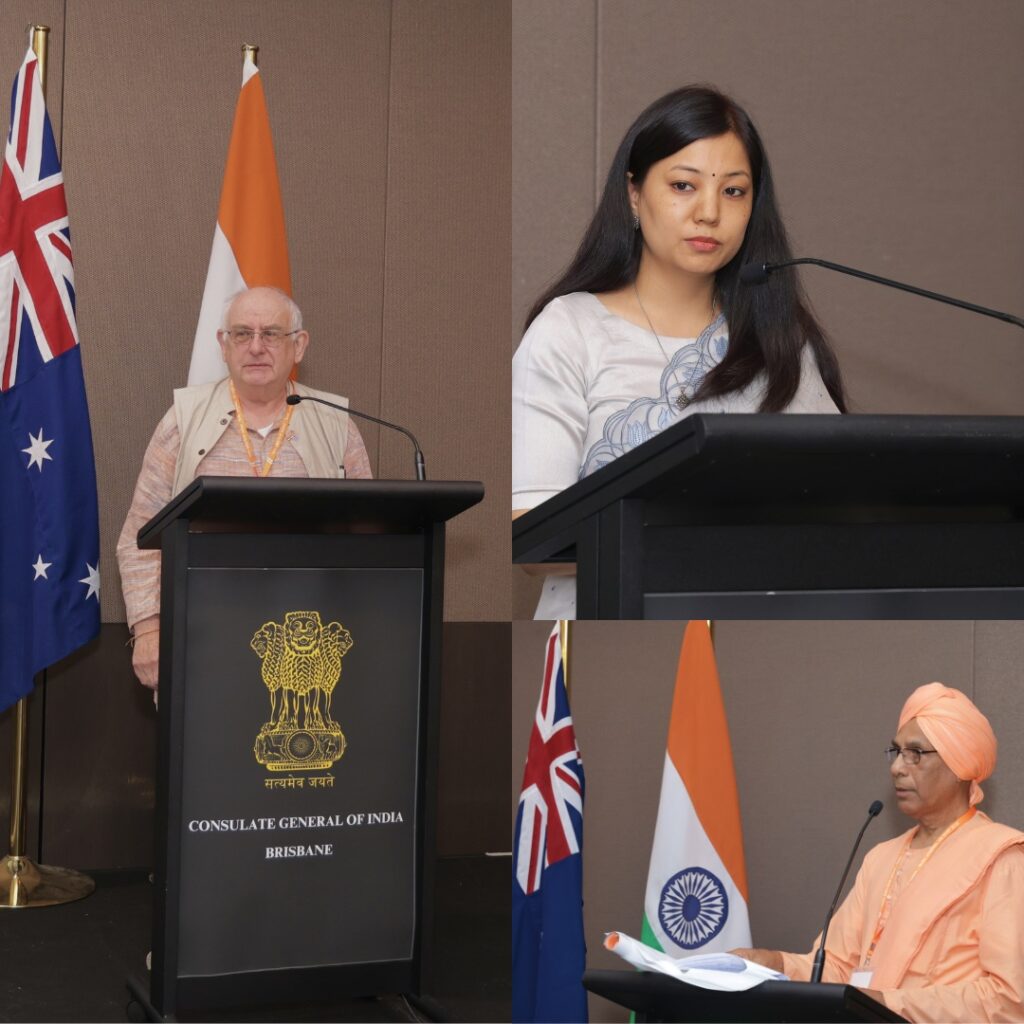
In his keynote, renowned scholar Dr Peter Friedlander, former professor at the Australian National University, reflected on language as a marker of identity. Drawing parallels with Mandarin in Singapore, he observed how languages standardize, adapt, and coexist with regional and social variations.
“Hindi continues to evolve, incorporating new vocabulary and modern terminology while remaining connected to its historical roots,” he said, reflecting on five decades of engagement. “The path of language, like the path of love, is eternal, always moving forward while remaining anchored in tradition,” he added, quoting Kabir.
From Dialogue to Direction: Key Recommendations from the Pacific Region
Deliberations across four thematic sessions covering diaspora institutions, Hindi education, technology, and regional perspectives converged on the need for “coordinated action, clear pathways, and sustained relevance” to secure the future of Hindi in the Indo Pacific, panelists said.
Coordination, Resources, and Teachers
“Across the Pacific, institutions are independently developing curricula and teaching materials, which leads to duplication and uneven standards,” noted a panelist. Delegates recommended a centralized resource repository, supported by Indian missions, to consolidate materials, share best practices, and sustain collaboration beyond the conference. Teacher availability also emerged as a key challenge. “Even where Australian schools are willing to offer Hindi, trained educators are limited,” a panelist added. A train-the-trainer model was proposed to expand teaching capacity rapidly across the region.
Bridging the Education Gap
Panelists highlighted a major concern: “Student attrition rises sharply from Year 5 through adolescence. While community Hindi schools support early learning, structured pathways between Year 5 and senior secondary years are largely absent. Some first-generation students continue Hindi in senior years, but younger learners, including those from non-Indian backgrounds have few opportunities to stay engaged.”
“Some Australian schools run ad hoc exchanges with India,” noted a delegate, “but cultural immersion programs, supported formally by Indian consulates, could allow multiple schools to participate consistently.” Existing initiatives such as the Know India Program, which starts at 21, were described as “too late to retain learners at a critical stage.”
Sustainable Youth Engagement
Delegates also recommended “a centralized framework to maintain continuity between conferences” and the identification of youth Indian-Australian ambassadors under 18, who could engage peers including non-Indian students in Hindi learning and cultural programs. “These ambassadors could help build a pipeline of young learners, ensuring Hindi remains relevant and vibrant,” a panelist explained.
Technology and Contemporary Language
Scholars stressed that “Hindi’s long-term vitality depends on its ability to function in modern, professional, and digital contexts.” They highlighted the lack of standardized terminology for contemporary tools and concepts, which results in ad hoc borrowing from English. A formal mechanism to regularly update technical and digital vocabulary was recommended, ensuring that Hindi “remains practical for education, work, and daily life, not confined to literature alone.”
Culture as a Pathway to Language
“Language learning is deeply connected to cultural domains such as yoga, Indic studies, music, and the arts. Expanding ICCR-supported programs beyond Sydney and the east coast was seen as essential, with these entry points driving retention, deeper learning, and soft power,” panelists added.
Girmitiya Legacy “We can learn from the Girmitiya experience,” the moderator said, explaining, “Girmitiya, from the word ‘agreement,’ refers to Indian indentured laborers sent to Fiji, Mauritius, the Caribbean and South Africa. It is more than a historical term; it is a symbol of cultural survival and pride.”
A fourth-generation Indo-Fijian delegate noted that knowing Hindi allowed her “to connect effortlessly with the people, traditions and civilization” on her “first visit to India at the age of twenty-two.”
Closing insight
The conference sessions concluded with the valedictory address by Swami Sanyuktanand, a Pravasi Bharatiya Samman Award recipient and President, Fiji Seva Ashram Association who reflected on the civilizational and spiritual continuity sustained through language. The vote of thanks was delivered by Irina Thakur, Deputy High Commissioner of India in Canberra, formally bringing the four thematic sessions of the conference to a close.
Closing Remarks and Cultural Evening
Closing the conference, CG Bhagotia thanked the delegates and special guests, including Australian Government representatives Bisma Asif MP, Councilor Penny Wolff and Charlie Shandil, Regional Director, Northern Region. She described the evening as a “reflection of the strong India-Australia partnership” grounded in “shared values of diversity, inclusiveness and mutual respect,” praising participants for affirming Hindi as a “living bridge between cultures and communities.”
High Commissioner Baglay said the conference “demonstrated the depth of engagement for Hindi across the region” while also expressing “India’s solidarity with Australia following the recent Bondi Beach terrorist attack.” Drawing on “India’s own long experience in confronting terrorism,” he praised “the resilience and unity of the Australian people.”
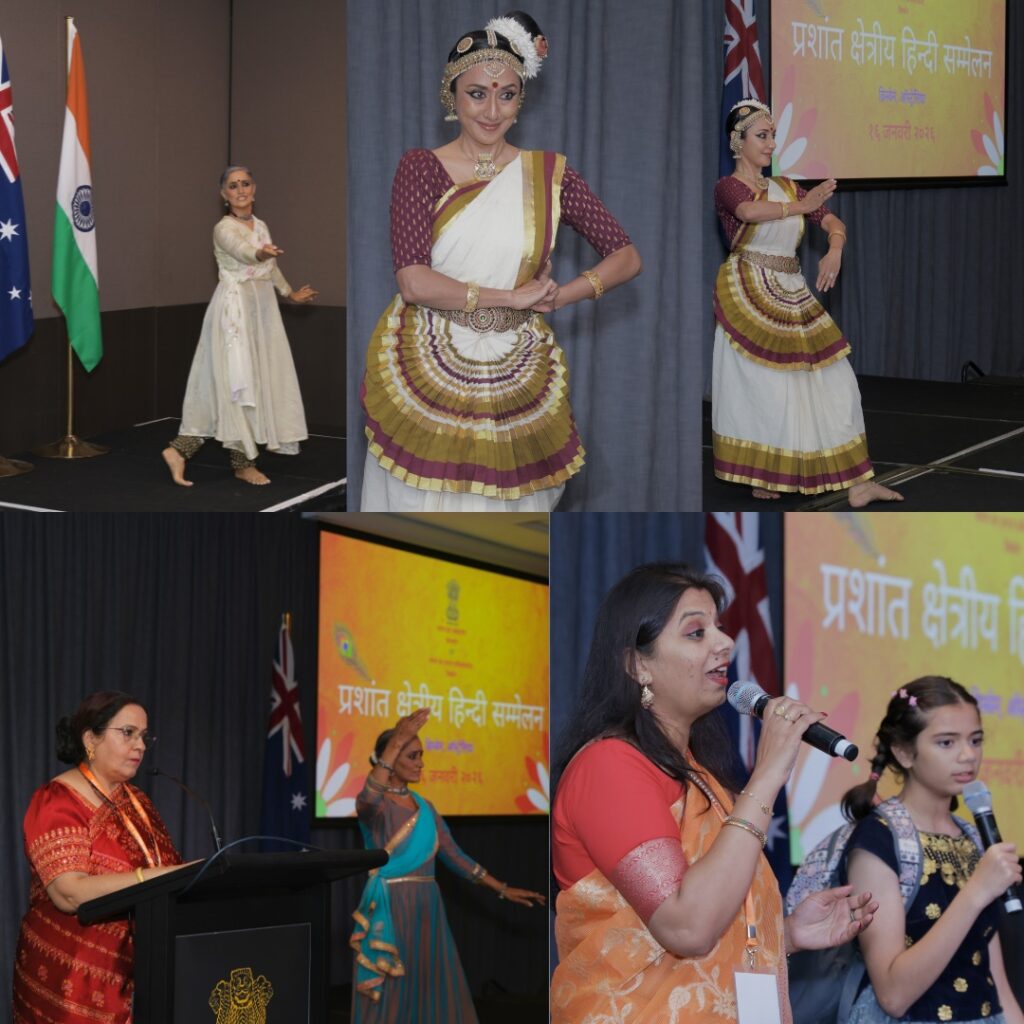
Secretary Malhotra concluded by acknowledging the recommendations, noting they would inform future policy and collaboration, as the evening closed with cultural performances and a gala dinner.
Related posts:
 Celebrating Hindi Diwas: Delhi Public School Rohini Echoes Hindi’s Timeless Spirit
 Permanent Mission of India to the United Nations Observes “Hindi Diwas 2024” at the United Nations
 Varun Ghosh Becomes First Indian Heritage Senator to Take Oath on Bhagavad Gita
 Australia and India Seal Three Defense Agreements as Defense Minister Rajnath Singh Concludes Two-Day Visit
