Join WhatsApp Channel


“Negotiation in the classic diplomatic sense assumes parties are more anxious to agree than to disagree.” — Dean Acheson
In early August last year, President Donald Trump, in his usual style of governing by decree, posted on Truth Social that he would impose an additional 25 percent tariff on India. With that announcement, he turned a disagreement into a blunt warning. India’s purchases of Russian oil, he argued, were the reason. The post landed like a gavel. It did not invite a conversation. It set a condition. Markets recalculated in real time, exporters stared at a narrower horizon, and diplomacy slipped into stalemate.
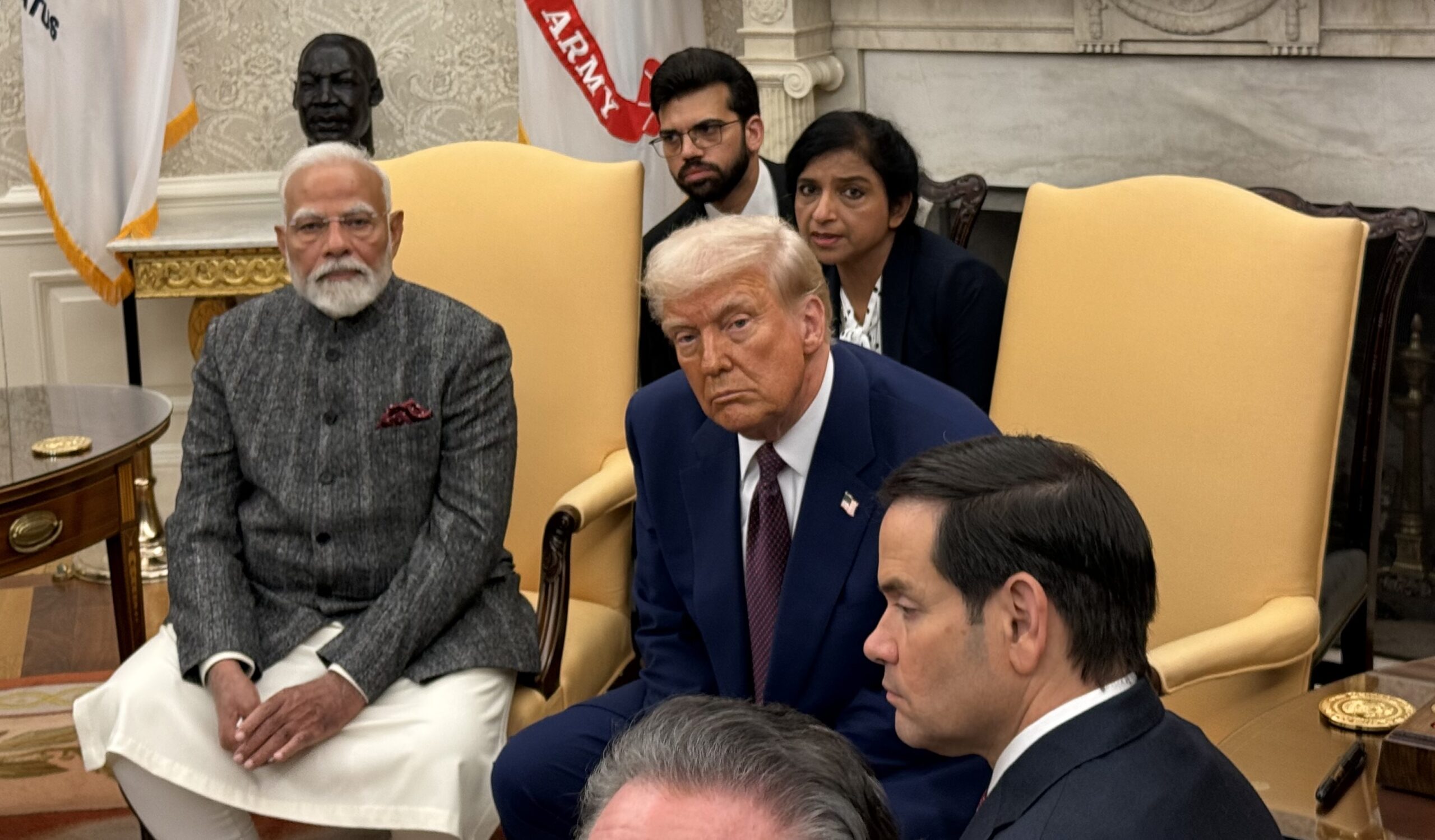
Fast forward to a cold February morning in Washington, when Trump returned to his own social media post after a call with Prime Minister Narendra Modi and described a new arrangement “whereby the United States will charge a reduced Reciprocal Tariff, lowering it from 25% to 18%.”
Modi responded by calling it a wonderful announcement and framed it as “When two large economies and the world’s largest democracies work together, it benefits our people and unlocks immense opportunities for mutually beneficial cooperation.” Those posts were not the bargaining itself. They were the public seal after weeks of hard exchange had already pushed the terms into place.
The timing is the tell. Only days earlier, India and the European Union closed a long-delayed trade pact that marked real tariff cuts and easier market access. Brussels called it the “Mother of All Deals.” Investors saw it as India widening its room to maneuver. Washington read it as something sharper, a reminder that when the United States tries to enforce trade discipline by threat, partners will look for predictability elsewhere and return with a stronger hand.
That also defines the stalemate, and why it finally broke. The stalemate was not a lack of channels. It was a lack of incentive, with tariffs doing the talking and both sides waiting for the other to blink. Once Europe signed, the cost of American delay rose. The United States risked watching investment decisions, sourcing choices, and standards pathways tilt toward an India that now had a major European lane open. Influence slips quietly in trade. It is lost not only in sales, but in the rules, others write while you hold back.
In a quiet way, the EU agreement pulled Washington back into the room. India did not need to announce its choices. It showed them. In trade, the most persuasive argument is rarely a speech. It is another partner ready to sign.
Coming on the heels of the EU India trade arrangement, the U.S. India understanding is a return to the basics, back to bargaining. Washington did not suddenly become generous. It recognized that threats have a shelf life when the other side can sign elsewhere.
Let’s be honest. India was never going to get the velvet rope treatment reserved for old treaty allies with supply chains welded over generations, the kind of advantage the UK, Canada under USMCA, and parts of Europe still enjoy. In recent arrangements, the United Kingdom has stayed near 10 percent and the European Union near 15 percent. Yet 18 percent changes the day-to-day math for Indian exporters, and it does so at a moment when several regional competitors remain stuck with harsher terms.
India’s new footing is an advantage rather than a concession. India did not get there by theatrics. It got there by staying in the room, broadening its options, and making cooperation more valuable than confrontation.
Behind the headlines were the crucial conversations that laid the groundwork. External Affairs Minister S. Jaishankar’s exchanges with U.S. officials, including Secretary of State Marco Rubio, were reported to center on critical minerals. Lithium, rare earths, and cobalt sit at the heart of electric vehicles, advanced chips, and modern defense production. By keeping the conversation there, India was not asking only for easier entry into the U.S. market. It was indicating that it can help secure what the next economy will run on, and that kind of value carries farther than any tariff line.
Both Trump and Modi underscored the political buy in by framing the agreement as a win-win moment. To be clear, this is not a sweeping free trade agreement that rewrites rules across the board. It is a targeted understanding, sector specific and transactional, built to lower select barriers while serving larger aims.
Trump’s own framing also hints at who believes they gained more. He wrote that India would “reduce their Tariffs and Non-Tariff Barriers against the United States, to ZERO,” and India was commitment to “BUY AMERICAN,” alongside over $500 billon of U.S. products. Plainly, that is not reciprocity. It is a maximalist wish list. Even if parts of it move, no government can wave away domestic politics, procurement rules, and price realities with a post. India can bide its time here. If Washington wants speed and scale, it will have to keep offering terms worth taking, because India now has proof that waiting is not the same as losing.
For Indian industry, the gains are practical. Engineering goods, textiles, apparel, chemicals, and pharmaceuticals get breathing room and a pathway into the American market. For Washington, the return is not only commercial. India signaled a willingness to tilt parts of its energy sourcing away from Russia and toward deeper purchases from U.S. suppliers, a move conditioned by price and supply realities, yet aligned with America’s wider geopolitical push.
Realistically, what this deal represents is a course correction, not a conversion. Washington spent months leaning on tariff threats that yielded little beyond uncertainty. Now it has taken a step back toward what works, negotiation that produces outcomes. India’s takeaway is just as direct. Autonomy does not mean standing apart. It means knowing when to enter, what to offer, and how to turn leverage into terms, be it minerals, energy, or market access.
Trade wars make noise. Trade talks make progress. If both sides follow through, if Washington resists the urge to govern by ultimatum and India keeps doing what it did here by holding the line on interests, the relationship can become more than a list of tariff lines. It can become a working habit, and that is where the title holds, because in the end, deals outlast diktats.
Disclaimer: The opinions and views expressed in this article/column are those of the author(s) and do not necessarily reflect the views or positions of South Asian Herald.