Join WhatsApp Channel


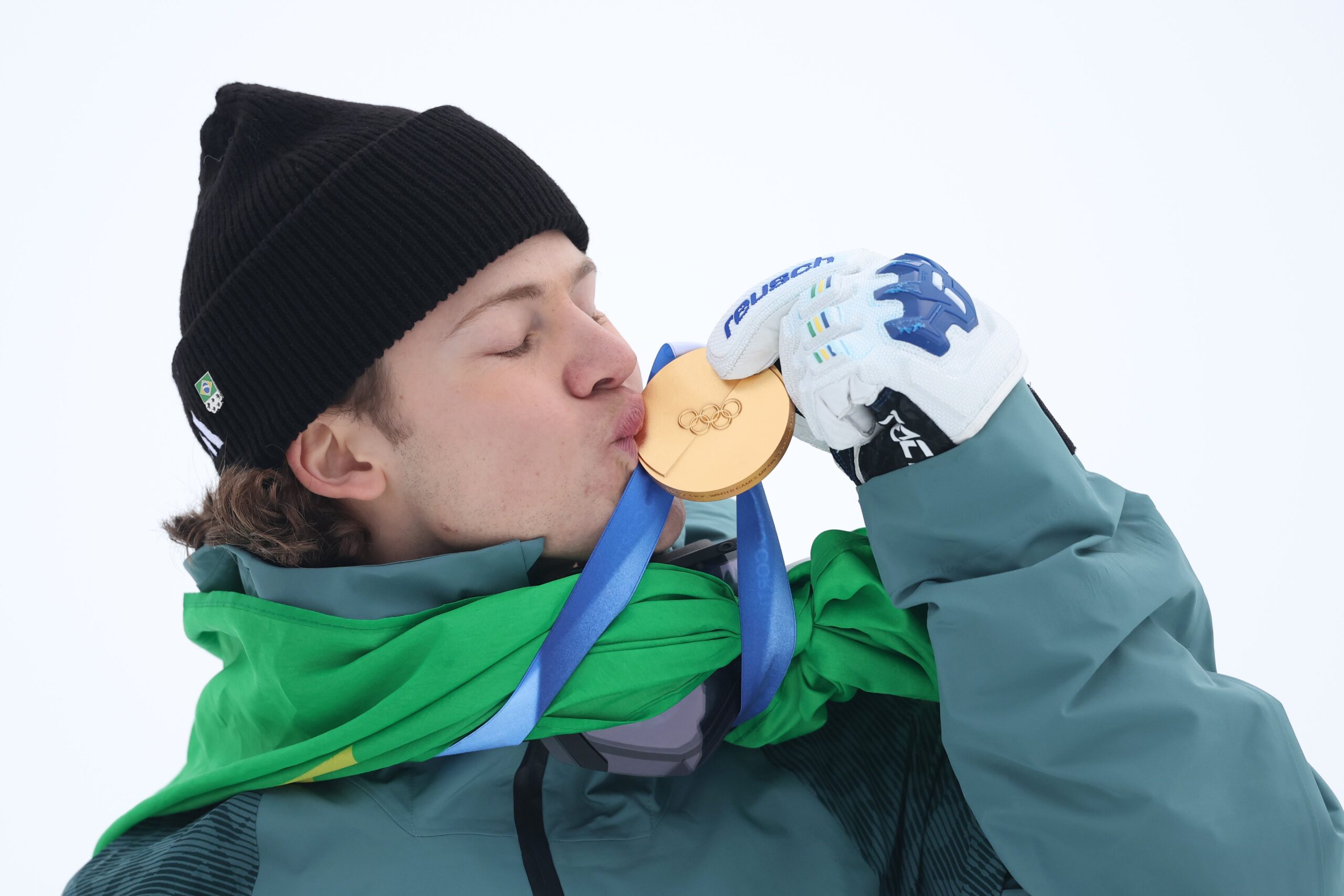
Every Olympic Games carries its own legacy. The Milano Cortina 2026 Winter Olympics will be remembered for several milestones, none more historic than Brazil securing South America’s first-ever Winter Olympic medal.
That landmark moment came through Brazilian alpine skier Lucas Pinheiro Braathen, who won gold in the men’s giant slalom on Saturday, delivering Brazil’s first Winter Olympic medal and the first for any South American nation.
Brazil is globally associated with beaches and football. At Milano Cortina 2026, however, it etched its name into snow. The 25-year-old Braathen, born in Oslo to Norwegian father Björn Braathen and Brazilian mother Alessandra Pinheiro De Castro Braathen, switched his sporting allegiance from Norway to Brazil two years ago. His decision has now yielded a historic Olympic title.
Braathen set the pace with a commanding opening run of 1:13.92. Although he placed 11th in the second run with 1:11.08, his combined time of 2:25.00 secured gold. Switzerland’s Marco Odermatt finished with silver in 2:25.58, followed by compatriot Loic Meillard with bronze in 2:26.17.
In an emotional post-race media interaction, Braathen received a congratulatory phone call from Italian skiing legend Alberto Tomba. “Lucas, bravo! Congratulations!” Tomba exclaimed. “Gold medal for Brazil, can you imagine?” Fighting back tears, Braathen replied “no.” Tomba added: “You cry like me, you are the best!”
Reflecting on his victory, Braathen said, “I’m not even able to grasp reality, as I stand here right now. I am just trying to get some sort of emotion here and translate it into words, even though it’s absolutely impossible.”
On what the achievement could mean for Brazil, he added: “I hope I can inspire some kids out there that, despite what they wear, despite how they look, despite where they come from, they can follow their own dreams and be who they really are. Because that is the real source of happiness in life.”
Braathen’s Olympic breakthrough builds on recent success. After retiring abruptly in 2023 while representing Norway, he returned to competition in June 2024 under the Brazilian flag. He earned Brazil’s first World Cup podium finish in December 2024 and has since accumulated 10 World Cup podiums, including the country’s first victory this season. At the 2022 Beijing Olympics, he recorded Did Not Finish results in both slalom and giant slalom while competing for Norway.
Before Braathen’s triumph, Brazil’s best Winter Olympic result was Isabel Clark’s ninth-place finish in snowboard cross at Turin 2006.
Beyond Brazil’s milestone, Milano Cortina 2026 has drawn global attention both on and off the field of play.
Two years after the Summer Olympics, prominent athletes including Novak Djokovic and Simone Biles were among high-profile attendees. Djokovic, fresh from reaching the Australian Open final, was seen with his wife Jelena watching the figure skating team event.
He applauded U.S. skater Ilia Malinin after his free skate secured gold for Team USA. “I did see Djokovic. It’s so unreal,” Malinin said. “I heard that after I landed my backflip, he had his hands over his head. That’s incredible. That’s a once-in-a-lifetime moment: Seeing a famous tennis player watching my performance. I’m absolutely blown away.”
Ahead of the Opening Ceremony, Milan’s La Scala opera house hosted a red-carpet gala attended by figures including five-time Olympic speed skating gold medalist Bonnie Blair, Donatella Versace, Usher, and Stanley Tucci.
On the competition front, Norway added two gold medals. The women’s 4×7.5km relay team secured victory ahead of Sweden and Finland, while Maren Kirkeeide won the women’s 7.5km biathlon sprint, finishing ahead of France’s Oceane Michelon and Lou Jeanmonnot.
The United States claimed its fifth gold medal of the Games in women’s dual moguls freestyle skiing through Lemley Elizabeth, while teammate Joelin Kauf took bronze.
Austria’s Janine Flock captured gold in the women’s skeleton, overcoming Germany’s Susanne Kreher and Jacqueline Pfeifer. Slovenia earned gold in the men’s large hill individual ski jumping event through Domen Prevc, with Japan’s Ren Nikaido taking silver and Poland’s Kacper Juraszek bronze.
Canada, still in pursuit of its first gold medal of the Games, found momentum in both speed skating and women’s ice hockey.
Speedskater Laurent Dubreuil won bronze in the men’s 500 meters with a time of 34.26 seconds, briefly setting an Olympic record before being surpassed by American Jordan Stolz, who won gold in 33.77 seconds, and the Netherlands’ Jenning de Boo, who secured silver in 33.88 seconds.
Dubreuil’s bronze marked Canada’s eighth medal of the Games and the country’s first Olympic medal in the men’s 500 meters since Jeremy Wotherspoon’s silver at Nagano 1998.
In women’s ice hockey, defending champion Canada advanced to the semifinals with a 5-1 victory over Germany. Captain Marie-Philip Poulin scored her 18th Olympic goal, tying the Canadian record held by Hayley Wickenheiser. Poulin became only the fourth woman to score in five Olympic tournaments.
As Milano Cortina 2026 continues, Brazil’s breakthrough stands as one of the defining stories of the Games, signaling a new chapter for winter sports in South America.
Related posts:
 Milano-Cortina 2026 Opens with Dual Cauldrons, Historic Venues, and a Global Call for Respect
 Milano Cortina 2026 Day 7: Klaebo Ties Winter Olympic Gold Record, Kazakhstan’s Mikhail Shaidorov Wins Gold
 Norway Leads Medal Table as Seoul Sister Choi Gaon, and Lollobrigida Headline Day 6 at Milano Cortina 2026
 Klaebo Wins Second Gold at Milano Cortina 2026 as Norway Extends Lead; USA’s Ogden Makes History with Silver